熊出没之夺宝熊兵
China’s top pork-producing province rolls out homegrown 'gene chip' for breeding quality pigs_我的网站

一 | Samantha Ruth Prabhu and Raj Nidimoru entered wedlock a few days ago! While the newlyweds are still receiving congratulatory messages, we have learnt that the couple would collaborate professionally to bankroll films.
Samantha, Raj collaborate professionally
Much before their wedding, Samantha and Raj collaborated as director and actor, and also as a co-producer. Last year, Samantha launched her production house, Tralala Moving Pictures under which she produced the film, Subham. Raj was credited as creative producer for the film while one of his associates oversaw the production. Similarly, for Samantha’s upcoming film, Maa Inti Bangaram, Raj is the creative producer. But according to sources, Raj would be elevated to not just overseeing creative aspects but also involved in financial decisions, officially. Samantha worked with Raj for projects like The Family Man and Citadel: Honey Bunny. She knew his rich experience as a producer will come in handy in bringing down the cost of her production ventures. So going forward, we can see Raj would be credited as ‘producer’ for all Samantha’s films. On the other hand, Raj continues to work on his own web series in collaboration with DK (aka Krishna Dasarakothapalli). The duo reportedly has a couple of Hindi web shows lined up, apart from two theatrical releases.
Sam-Raj to continue work from Hyderabad
While Samantha and Raj have a residence in Mumbai, they continue to operate from Hyderabad where they also have a home. Both of them are set to return home shortly and resume work for their respective projects. Samantha is also in talks to headline a couple of Telugu films. It is being speculated that she is likely to announce them shortly. While balancing production (in collaboration with her husband Raj Nidimoru), Samantha aspires to act in films, although she is selective in picking up films.
Also Read: Samantha Ruth Prabhu Reacts to Sheetal Nidimoru’s Heartfelt Post on Wedding。
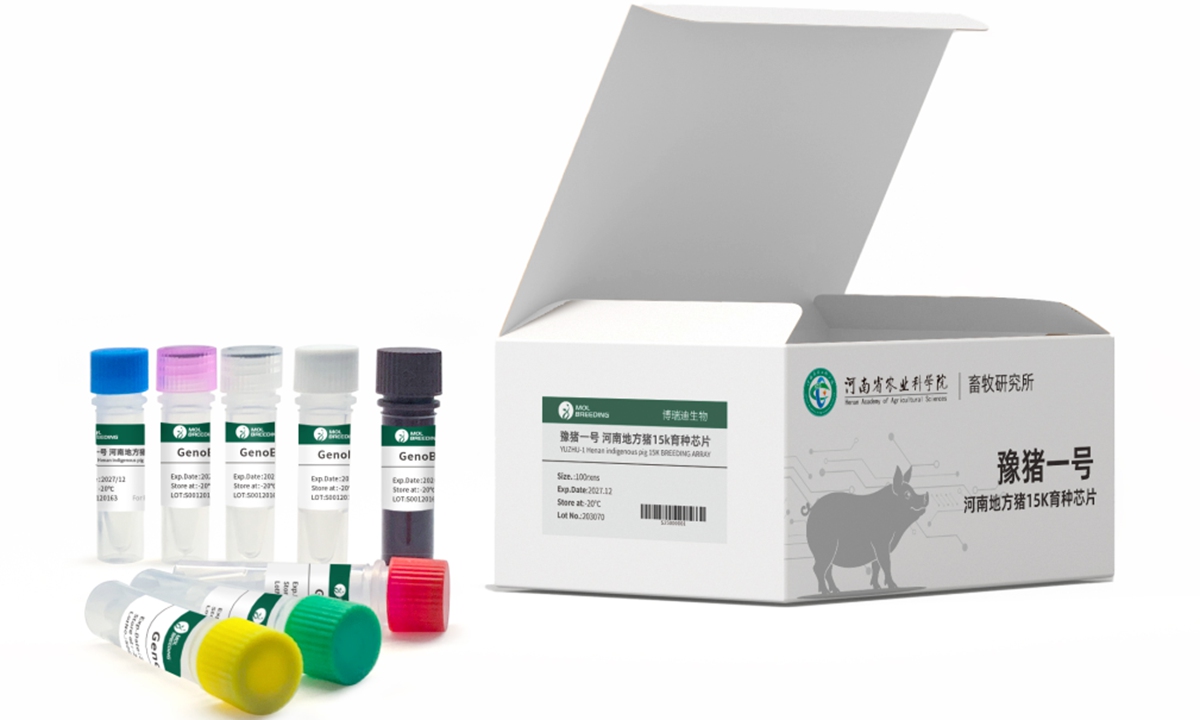
Yuzhu-1 Henan indigenous pig 15k breeding array Photo: Courtesy of Institute of Animal Husbandry and Veterinary Science of Henan Academy of Agricultural Sciences
China's largest pork-producing province has introduced a genomic breeding tool designed for indigenous pig breeding, a sign that the province is shifting from expanding volume toward improving hog quality.
The Henan Academy of Agricultural Sciences announced the launch of Yuzhu-1 Henan indigenous pig 15k breeding array - commonly known as a gene chip - developed by the pig breeding team at its Institute of Animal Husbandry and Veterinary Science. It is the first such tool customized for the province's native pig stock, the institute said on Monday.
Henan is home to multiple native pig breeds prized by consumers for their good flavor. However, they carry a commercial burden compared with imported lean-meat breeds, as they grow more slowly, consume more feed per kilogram of weight gain and deliver thinner margins, noted Xing Baosong, head of the pig research office at the institute.
Lifting those hurdles depends on sharper selection, which in local herds has long relied on visual assessment of physical traits, which is slow and imprecise. Genomic tools can speed things up, but mainstream commercial chips were built on imported breeds and lose accuracy on native Chinese stock. Yuzhu No 1 instead draws on whole-genome resequencing data from five of Henan's native pig breeds and two locally bred lines.
"In breeding we rely on estimated breeding values to judge an animal's genetic potential," Wang Ligang, a professor at the Institute of Animal Sciences under the Chinese Academy of Agricultural Sciences, told the Global Times on Monday. "An array matched to the breed makes that estimate more accurate. Previously there was a real chance we were selecting the wrong animals. Now we are far more likely to be selecting the right ones - and to select accurately for the traits a breed is known for, whether that is tender meat or high fertility."
The efficiency gap between native and imported pig breeds remains wide, said Wang, who is also with the Pig Branch of the Chinese Association of Animal Science and Veterinary Medicine. Feed conversion ratios for local Chinese pigs run around 3.0, against below 2.5 for imported breeds, while reaching 100 kilograms takes native pigs 180 to 190 days compared with 130 to 140 days for exotic lines, he said.
Despite this, China's native pig breeds have their advantages.
"Our pigs taste better, partly because they are raised longer," Wang said. "And they are far more robust. Exotic breeds can suffer heat stress and die in summer; when disease hits, they can go down in large numbers. Local pigs rarely do. They tend to recover. Some breeds in Northeast China can even tolerate severe cold."
He added that imported breeds drive efficiency, while native breeds ensure quality and offer a reservoir of genetic diversity for disease and stress resistance - traits that can be bred back into commercial lines.
The province slaughtered 64.74 million pigs in 2025, up 7.4 percent year on year, with pork output at 5.22 million tons, according to the provincial statistics bureau, making it the top pork and pig producer nationwide, according to industry statistics.
In the first half of 2026, pig slaughter in the province rose a further 6.4 percent, accelerating 5.3 percentage points from the first quarter, against national growth of 1.7 percent. Xing said that more high-quality local black pigs will reach the market as Yuzhu No 1 is applied more broadly.
Other major pig production provinces such as Southwest China's Sichuan, Northwest China's Shaanxi and South China's Yunnan have all developed their own arrays.
"Provinces with the most developed pig production are the ones pushing upmarket," Wang said. "Scale is no longer the only measure. If every province reaches this level, a pattern of one dedicated array per province could gradually take shape for China's native breeds."
。
Current article:http://fe25l.yinkataizengquge.bond/owr/3502t.html
Published on:16:38:44


