天国的嫁衣
宣布辞职后就不忍了?加拿大总理特鲁多在美国接连回怼特朗普吞并论_我的网站

A |
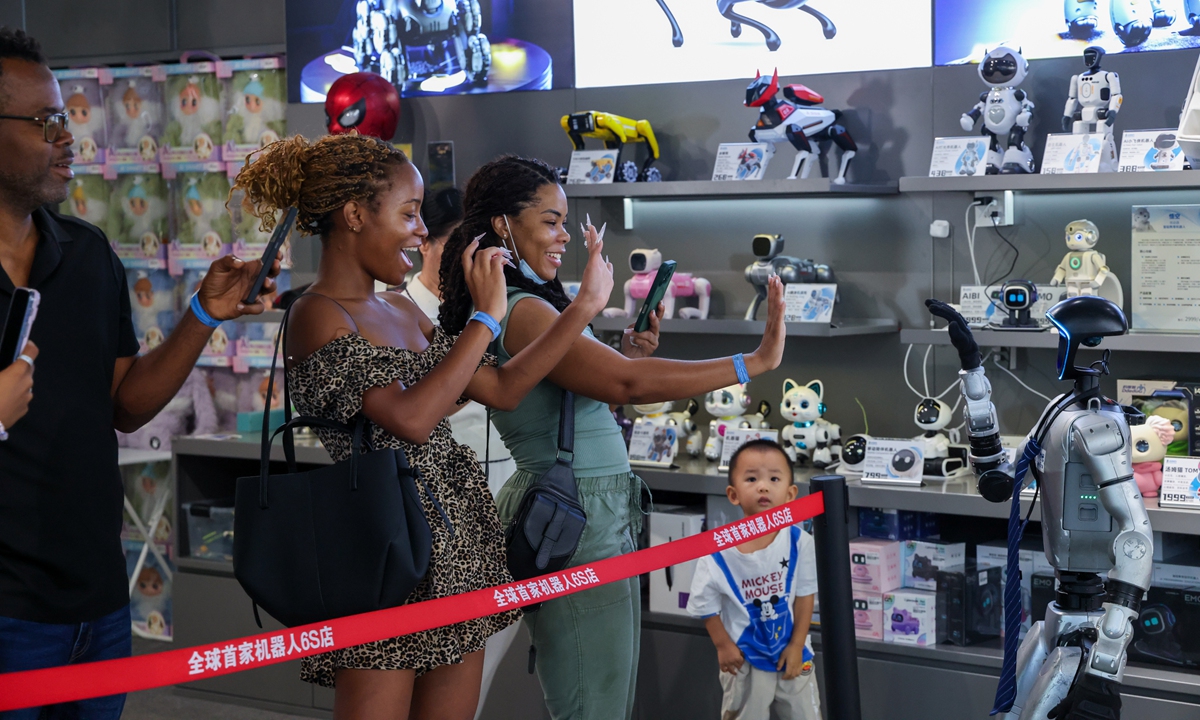
Photo released on August 9, 2026 shows tourists from Jamaica interacting with a humanoid robot at the world's first robot 6S store in Longgang District, Shenzhen, South China's Guangdong Province, on August 4. Photo: XinhuaChina's cutting-edge industrial upgrade witnessed two major landmarks on Monday, marking the country's full-fledged global lead in humanoid robotics and further solidifying the rise of its "new new three" strategic sectors — robotics, artificial intelligence and innovative medicine.
Industry data showed that Chinese vendors accounted for more than 97 percent of global humanoid robot shipments in the first half of 2026. Additionally, Chinese robotics firm Unitree Robotics began its share subscription process for its listing on Shanghai's stock market, becoming the first humanoid robot A-share stock.
The global humanoid robot shipments reached approximately 19,100 units in the first half of the year, surging 272 percent year-on-year. The market saw a leadership shift, with Chinese robotic company AGIBOT overtaking Unitree to become the world's largest humanoid robot vendor. China also represented more than 85 percent of global demand, according to the latest research from Smart Analytics Global (SAG).
As the former global leader in 2025 with annual shipments of 5,500 units, Unitree Robotics set its IPO offering price at 150.8 yuan ($22.35) per share on Monday. The initial public offering (IPO) is expected to raise 6.1 billion yuan, meaning an estimated market capitalization of around 61 billion yuan, according to media reports. The final online subscription winning rate will be 0.0181 percent, Unitree said on Monday.
The breakthroughs in humanoid robotics represent the latest landmark of China's booming "new new three" industries, which are emerging as core pillars driving the country's high-end manufacturing upgrade, export expansion and future economic growth.
Driving forces The rapid and comprehensive rise of China's robotic sector stems not merely from policy incentives, but from integrated advantages in complete manufacturing chains, forward-looking institutional arrangements and massive real-world application scenarios, industry analysts noted.
"The answer lies not in mere policy slogans, but in the synergies rooted in its manufacturing base, early institutional frameworks, and vast application scenarios. These factors have driven the 'new new three' industries onto the global stage," Zhang Xiaorong, director of the Beijing-based Cutting-Edge Technology Research Institute, told the Global Times on Monday.
A robust supply chain has been decisive. The localization rates across China's robot industry chain have risen markedly in 2026, with core components shifting to domestic control, CCTV News reported, citing an executive of a Shenzhen-based robot company, who said that more than 90 percent of key parts for its humanoid robots are sourced domestically.
"No other market is better suited for the robotic industry than China," the executive said.
Institutional analysis noted that the domestic production rate of Unitree Robotics' supply chain reaches 90 percent, while all core components are fully self-developed.
Zhang also said the large domestic market serves as a unique testing ground.
"Strong robot exports reflect advances in complete machine design, system integration, scenario algorithms, rapid delivery, and cost control, alongside continued localization of reducers, servo systems, and sensors. Large-scale applications in new energy vehicles, electronics manufacturing, and warehousing provide frequent iteration and engineering validation," said Zhang.
Institutional foresight also played a role. Robot manufacturing was first listed as an independent industry in the national standard for industry classification in October 2017, with sub-categories including "industrial robot manufacturing" and "special operation robot manufacturing" following in 2023.
Analysts noted that this early classification facilitated later policy support, capital-market positioning, and statistical monitoring.
In June 2026, several ministries launched a special program for real-scenario training of humanoid robots and embodied AI.
Customs adjustments, effective from January 1, added specific tariff codes for intelligent biomimetic and cleaning robots, simplifying export clearance.
Insurance coverage also followed. In June, China Export & Credit Insurance Corp issued an insurance policy for AGIBOT's embodied robot export project, providing overseas risk coverage.
Supported by complete industrial chains, rich scenarios and systematic policy guarantees, China's robotic sector has built an unshakable global edge, experts noted.
A faster paceOfficial data showed that China has more than 400 complete humanoid robot models - over half the global total - while quadruped robots account for nearly 70 percent of worldwide sales.
"China may produce more than 100,000 humanoid robots this year, with even higher growth expected in the following years, pointing to long-term opportunities in a sector with deep potential," Yang Delong, chief economist at Shenzhen-based First Seafront Fund, told the Global Times on Monday.
China's robot export momentum has also reached new heights. After becoming a net exporter of industrial robots for the first time in 2025, China's industrial robot exports reached 6.29 billion yuan in the first half of 2026, reaching 141 countries and regions, official statistics show. Surgical robot exports rose 3.3 times year-on-year. Overall robot exports grew 359 percent.
AGIBOT, the champion of humanoid robot shipment so far this year, illustrated the rapid scaling: Its 15,000th embodied AI robot rolled off the line on June 28, less than three months after the 10,000-unit milestone.
All units are being delivered to domestic and overseas customers for use in 3C (computer, communication and consumer electronics) manufacturing, warehousing and logistics, and commercial services, AGIBOT told the Global Times.
Jiang Qingsong, company partner and co-president of AGIBOT, told the Global Times on Monday that the company aims for overseas sales to exceed 30 percent of its total in 2026 and potentially surpass 50 percent later.
Strong progress in robotics is closely backed by China's booming artificial intelligence sector.
Hugging Face's latest report found that over the past year, "Chinese models quickly accounted for the plurality or 41 percent of downloads," surpassing the US for the first time.
On the OpenRouter platform, Chinese AI models' token usage reached 34.25 trillion in the week ended Sunday, meaning roughly half of global share, while remaining ahead of US models for the 15th consecutive week.
Yang noted that China's AI progress is supporting growth across six frontier sectors - robotics, semiconductors, computing power and algorithms, commercial spaceflight, solid-state batteries, and biomedicine.
In terms of innovative drugs, by the end of 2025, China had 4,751 innovative drugs in development - 33.7 percent of the world total - making it the global leader in the pipeline.
Outbound licensing deals totaled about $110 billion in the first half of 2026 - already 80 percent of the full-year 2025 figure - with Chinese firms occupying eight of the global top 10 pharma deals. During the same period, 38 innovative drugs were approved, according to data from National Medical Products Administration.
Benefit the worldThe vigorous rise of the "new new three" industries marks China's third major upgrade in export structure, following the traditional "old three" (garments, furniture and home appliances) and the "new three" (new energy vehicles, lithium-ion batteries and photovoltaics). Each industrial iteration features higher technological content, stronger innovation capacity and deeper integration into the global economy.
China's breakthroughs in robotics, AI and innovative medicine deliver tangible benefits to global industries and consumers.
For example, AGIBOT's European representative Sandy Liu told the Global Times that universities and large manufacturers in automotive and warehousing are the company's main users in Europe, driven by rising labor costs and the need for new solutions.
Chinese open-source AI models have transformed high-end artificial intelligence technology from exclusive luxury resources into affordable, accessible digital infrastructure, benefiting global startups and developing economies. Innovative drug outbound licensing also accelerates global research collaboration and improves global patient access to cutting-edge treatments, analysts pointed out.
China's role in global trade is shifting from single manufacturing links toward a deeper embedding in technology, systems, and standards. What remains constant is the innovation that injects valuable certainty into the world economy and supports more inclusive globalization, analysts noted.
。

B | 当地时间1月6日,加拿大总理特鲁多宣布辞去自由党领袖一职,他将继续担任加拿大总理,直到党内选出新领袖。但就在他宣布辞职消息后不久,特鲁多于近日在美国华盛顿参加美国前总统卡特的葬礼期间,接受了多家美国媒体的采访。似乎是因为已经宣布了辞职,而没有了什么顾虑,特鲁多在接受采访时“火力全开”,多次就特朗普所谓的“美国吞并加拿大”的言论回怼。特朗普扬言吞并加拿大特鲁多:我说拿你们加州换 他立刻没了兴趣视频加载中...△视频:加拿大总理特鲁多接受美国媒体MSNBC采访视频当地时间1月10日,加拿大总理特鲁多在接受美国媒体采访时表示,他最近在美国佛罗里达州海湖庄园与美国当选总统特朗普会晤时,特朗普提出要把加拿大变成美国第51个州。作为对此的回击,特鲁多要求特朗普把加利福尼亚州或佛蒙特州拿出来交换加拿大的部分领土。

C | 特鲁多说:“(吞并)实际上曾经被提起过,然后我们开始反复思考这个问题。我于是建议‘好吧,也许可以用佛蒙特州或加利福尼亚州来交换(加拿大的)某些地区。’他(特朗普)立即觉得这个话题不那么有趣了,我们于是转到了另一个话题。”在采访中,特鲁多再次强调,特朗普提议对从加拿大进入美国的商品征收25%的关税,这不仅会提高美国几乎所有商品的价格,而且加拿大也将“做出强烈回应”。特鲁多还拿特朗普在上个任期对加拿大征收钢铝关税一事为例。他说:“我们的回应是对威士忌、摩托车、橙汁、扑克牌等商品征收关税,加拿大人不仅可以找到替代品,还可以减少支付的费用”。特鲁多在美正面回应: 美国吞并加拿大不会发生此外,特鲁多在接受美国另一家媒体,美国有线电视新闻网(CNN)的采访时也表示,特朗普炒作的吞并加拿大“不会发生”,加拿大人对自己是加拿大人“感到非常自豪”。视频加载中...特鲁多在接受采访时表示,加拿大人对自己的定义有很多种,但我们都使用的一种表达方式是“我们不是美国人”这一点不会改变。特鲁多还称,特朗普是“一位非常有技巧的谈判者”。他制造了一场“关于吞并加拿大的辩论”,以回避讨论其关税计划可能造成的经济后果,而这点恰恰需要得到更多的关注。报道称,去年11月,特朗普威胁要对加拿大和墨西哥商品征收25%的关税。加拿大商会商业数据实验室估计,若特朗普兑现承诺增加关税,加拿大将加征报复性关税进行反击,此举将导致美国的国内生产总值缩水4670亿美元,平均到每个美国人身上的损失是每人1300美元。特朗普放出关税威胁 特鲁多急赴海湖庄园当地时间2024年11月25日,美国当选总统特朗普在社交媒体上发文称,在2025年1月20日他就职后,将签署必要文件,对从加拿大、墨西哥进口到美国的所有产品征收25%的关税。消息一出,多家媒体随后便纷纷报道称,加拿大总理特鲁多将于2024年11月29日突访特朗普的住所海湖庄园,同特朗普讨论关税相关议题。当天稍晚,特鲁多抵达海湖庄园,并与特朗普就关税问题进行了讨论,但相关会谈并未取得实质性进展。视频丨特朗普要吞并加拿大?特鲁多在美正面回应:不会发生>>监制丨陆毅制片人丨赵新宇记者丨张森主编丨金律成编辑丨李佳宁©2025中央广播电视总台版权所有。未经许可,请勿转载使用。责任编辑:李佳宁。
Current article:http://fe25l.yinkataizengquge.bond/lvzp8/5mdd2xt.html
Published on:16:38:43
